


.svg)
.svg)
.svg)
.svg)

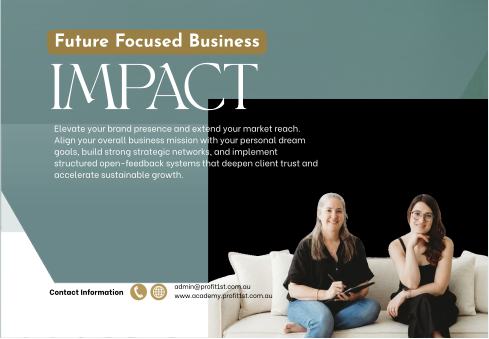
Future Focused Business: Impact

Coach
What Will You Learn?
About This Course
Create genuine transformation for clients, people, and community.
When your business is financially healthy and operationally smooth, your focus naturally evolves beyond day-to-day survival. With Tiers 1–4 complete, you have the stability and margin required to focus on deep, lasting value creation.
Impact is Tier 5 of the Future Focused Business program. In this tier, we focus on elevating client outcomes, nurturing a thriving culture for your team, and creating meaningful contribution within your industry and community—without sacrificing business performance.
What you'll accomplish in this tier
Through practical workbooks, impact frameworks, and guided video modules, you will:
- — Elevate Client Results & Experience: Deepen your core service delivery to drive transformative, long-term outcomes for every client you serve.
- — Build a Purpose-Driven Culture: Align team culture around shared mission and accountability, creating a workplace that attracts and retains top talent.
- — Design Purposeful Giving & Community Ties: Integrate sustainable philanthropic or community initiatives directly into your business model.
- — Prepare for Tier 6 (Legacy): Lay the emotional and strategic groundwork for a business that endures far beyond your daily presence.
Learn it, apply it, bring it to the group
- — Practical Workbook: Complete value-mapping tools and impact design exercises tailored to your organization.
- — Short Teaching Videos: Concise modules detailing frameworks for culture, client success, and intentional contribution.
- — Weekly Group Coaching (Optional): Refine your purpose-driven initiatives and leadership strategy with your coach and peer community.
$2,200 inc. GST
Paid in full upon release. Requires completion of Tiers 1–4 to ensure your broader impact is built on a stable, highly efficient, and profitable engine.
Requirements

FAQ
Check the frequently asked questions about this course.
Prerequisites
Prerequisites must be completed prior to taking this course.
Recent Reviews
See what course members are saying about the course.

.svg)
Curriculum Overview
This course includes 5 modules, 17 lessons, and 10:00 hours of materials.
Test Summary
This workbook has three parts. Part One asks you to find the evidence of transformation already happening in your business — real examples, not aspirational ones. Part Two turns that evidence into a single Impact Statement: who you help, and what actually changes for them because of the work you do. Part Three checks whether your current marketing reflects that impact, or whether it is still selling the transaction while the transformation goes unspoken.
Work through it honestly. A transformation you cannot point to with a real example is just a hope — and an impact no one can hear in your marketing is not really being offered at all.
Test Description
Test Summary
This workbook has three parts. Part One helps you find out, honestly, whether your business is currently mission-driven or role-driven — for leadership and for the team. Part Two is a facilitation guide for running two real alignment sessions: one with leadership first, then one with the wider team. Part Three is a step-by-step guide to refining and defining a mission statement that is specific enough to actually change how decisions get made.
Work through it in order. A mission session run before leadership is genuinely aligned tends to surface — and spread — the same misalignment it was meant to fix.
Test Description
Test Summary
This workbook has five parts. Part One checks whether the people who carry the most weight — the owners and shareholders — are actually pulling in the same direction. Part Two defines what alignment looks like in practice, so you know it when you see it. Part Three gives you a repeatable way to ask your team about their individual dreams and score how well those dreams line up with the business's grand vision. Part Four is what to do when the answer comes back misaligned. Part Five builds a daily habit — a mind movie or vision video — that keeps the business's own direction alive and specific in your mind.
Work through it honestly, and revisit it at least once a year. People's dreams change as their lives change — an alignment check that was true two years ago may not be true today.
Test Description
Test Summary
This workbook has three parts. Part One maps your current feedback process — when it happens, how it is collected, and whether it genuinely makes room for criticism as well as praise. Part Two turns whatever feedback you already have into a documented list of real improvement areas. Part Three builds the habit that keeps feedback alive: a simple three-step loop — Receive, Give, Act — so that feedback doesn't just get collected, it gets used.
Work through it honestly. A feedback process that only ever surfaces compliments isn't open — it's just filtered. The businesses that improve fastest are the ones that go looking for the criticism, not just the ones that are comfortable receiving it when it shows up.
A live companion to the Open Feedback workbook (module 21) — log every piece of feedback, move it through Receive → Give → Act, and track the pattern over time.
Test Description
Test Summary
This workbook has three parts. Part One documents a real, repeatable process for collaborating with other businesses — and a way to track whether you actually do it, with whom, and what came of it. Part Two builds a list of quality referrers you trust enough to put your own name behind. Part Three brings both together into a "Circle of Safety" — a defined, shareable set of complementary businesses you can confidently hand your clients to, for everything you don't provide yourself.
Networks isn't about referral trading for its own sake. A weak referral costs you trust with a client who followed it. A strong network — built deliberately, reviewed honestly — is one of the most valuable things you can hand a client that costs you nothing to give.
This workbook helps you build and strengthen your professional network by identifying trusted referral partners and tracking valuable business relationships. Use the Circle of Safety tab to document the key professionals and service providers you confidently recommend to clients, and the Collaboration Log tab to record and manage relationships with vendors, partners, and competitors. Together, these tools provide a structured approach to developing a strong, reliable network that supports both your business growth and client success.
Test Description
Course Certificate
Giorgina Sarmiento
This Course Includes
Course Specifications

.svg)
Subscribe to Our Newsletter


Popular Categories
Profit First & Cash Flow Business Coaching & Growth Tax & ATO Compliance Software & Tech TrainingContact US


Reply to Comment