


.svg)
.svg)
.svg)
.svg)

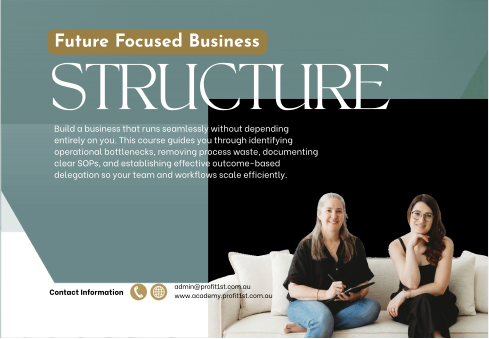
Future Focused Business: Structure

Coach
What Will You Learn?
About This Course
Run efficiently, with the right people in the right roles.
A business cannot hold weight if its operations rely entirely on the owner's constant involvement. With your financial baseline clear (Tier 1), sales steady (Tier 2), and profit secured (Tier 3), Tier 4 focuses on turning daily operations into scalable, repeatable systems.
Structure is Tier 4 of the Future Focused Business program. In this tier, we build robust operational workflows, document essential Standard Operating Procedures (SOPs), and structure team responsibilities so your business runs smoothly, efficiently, and independently.
What you'll accomplish in this tier
Through practical workbooks, operational blueprints, and targeted video lessons, you will:
- — Map & Streamline Core Workflows: Identify operational bottlenecks and streamline core business processes for maximum efficiency.
- — Build Systemized SOPs: Document key administrative and client-facing procedures so quality remains consistent across the team.
- — Optimize Team Roles & Accountability: Clarify role descriptions, delegate effectively, and align team capacity with financial budgets.
- — Prepare for Tier 5 (Impact): Free up your time as an owner so you can lead strategic expansion and broader market impact.
Learn it, apply it, bring it to the group
- — Practical Workbook: Complete role-mapping matrices, delegation frameworks, and process templates for your business.
- — Short Teaching Videos: Step-by-step training on systemizing operations and building clear SOP structures.
- — Weekly Group Coaching (Optional): Review your operational systems and team structures with your coach and peer community.
$2,200 inc. GST
Paid in full upon release. Requires completion of Tiers 1–3 to ensure your operational expansion is backed by a profitable, financially sound model.
Requirements

FAQ
Check the frequently asked questions about this course.
Prerequisites
Prerequisites must be completed prior to taking this course.
Recent Reviews
See what course members are saying about the course.

.svg)
Curriculum Overview
This course includes 5 modules, 19 lessons, and 10:00 hours of materials.
Test Summary
This workbook is where you build that model, one category of waste at a time.
It has five parts, one for each type of waste: bottlenecks, slowdowns, inefficiencies, overspending, and over-capacity. Each part walks you through the same simple pattern — identify it, understand why it's costing you, and choose a strategy to reduce it. By the end you'll have a single ongoing model you can return to every quarter.
Work through it the way you would any other Profit First resource: honestly, one process or one account at a time, without trying to fix everything on day one. Waste reduction is a habit, not a one-off project — the model at the back of this workbook is designed to be used again and again.
Review every recurring cost. Decide: Keep, Reduce, Cancel, or Needs Review.
Test Description
Test Summary
This workbook takes a deliberate approach instead: mapping the team you actually need, understanding the team you actually have, and closing the gap between the two on purpose.
It has three parts. Part One walks you through building an org chart — the simplest tool for seeing reporting lines, gaps, and overlaps at a glance. Part Two is talent mapping: an honest look at who is on your team right now, what they are genuinely good at, where they struggle, and whether those gaps are already being covered by someone else. Part Three brings it together by comparing your current team structure with your ideal one, so the gap becomes a plan rather than a feeling.
Work through it in order. You cannot design the ideal structure until you can see the current one clearly — and you cannot see the current one clearly until it is on paper in front of you.
This workbook builds a printable, one-page org chart directly from your team data — no drawing required. Enter names and roles once on the Your Org Chart Data tab, and the Your Org Chart (Visual) tab updates automatically. It follows the same structure as Part One of the Team workbook.
Test Description
Test Summary
This workbook has three parts. Part One is an honest look at how decisions actually get made in your business today, and whether that is genuinely working or just familiar. Part Two asks whether your team is currently empowered to resolve problems themselves, or whether they are quietly waiting on you for things they could already handle. Part Three builds the tool that fixes the gap: a Decision-Making Matrix that spells out, in plain terms, who can decide what — and gives you a template, a worked example, and a step-by-step guide to roll it out with your team.
Work through it in order. The matrix in Part Three only works if it is built on an honest picture of what Parts One and Two reveal — not on how you wish decisions were being made.
This workbook is the companion tool to the Outcome Delegation workbook. Use it to record every recurring decision in the business, assign it a level of decision authority, and track the gap between where each decision sits today and where you want it to sit.
Test Description
Test Summary
This workbook has four parts. First, you’ll honestly assess whether your business is designed to keep running when key people are out. Second, you’ll identify exactly which roles are hardest to cover. Third, you’ll document the actual processes for the tasks that matter most — in enough detail that someone else could follow them. Fourth, you’ll decide where those processes will live so they’re actually findable when you need them.
Work through it in order. You can’t document a process for a role you haven’t identified as high-risk — and a documented process nobody can find is no better than no process at all.
This companion tracks the same four steps as the Team Contingency workbook, but keeps them live and calculated instead of static.
Test Description
Test Summary
This workbook has two parts. Part One asks you to justify your reputation with real evidence, not just confidence — what you are actually known for, and what proves it. Part Two builds your Unique Selling Point: the specific point of difference that explains why a client should choose you over any other option, documented clearly enough that you and your team can say it the same way, every time, in every channel.
Work through it honestly. A reputation you cannot back up with evidence is just an opinion — and a point of difference no one can repeat is not really being communicated at all.
Test Description
Course Certificate
Giorgina Sarmiento
This Course Includes
Course Specifications

.svg)
Subscribe to Our Newsletter


Popular Categories
Profit First & Cash Flow Business Coaching & Growth Tax & ATO Compliance Software & Tech TrainingContact US


Reply to Comment